China’s indisputable leadership in clean energy investment has long commanded the attention of international leaders and corporations alike. In 2024, they contributed 31% of global investment in renewable energy – over double that of the USA. They have been working consistently behind the scenes, ensuring the potential of the renewable energy sector is fully realised. Although their approach, like any, has been far from perfect, their efforts highlight the impressive progress that can be made when nations are uncompromisingly decisive.
For the past three decades, Chinese economic growth has been buttressed by an overwhelming dependence on coal. Although the economic and societal change this power source enabled is undeniable, it resulted in the government having to confront multiple crises involving air and water pollution, along with the resulting public unrest. Diplomatic disadvantages that came with being the world’s biggest polluter also forced them to realise that an upheaval of their energy system was critical.
Wasting no time, a five-year plan was established in the mid-2000s to increase their clean energy capacity. Within a decade they dominated global supply of solar and wind technologies. The speed and scale of this adoption of renewables has since been unmatched. In 2022, they installed as much solar capacity as the rest of the world combined, continuing to grow 46% by 2025. Windswept deserts in their northern territories provided the perfect environment for this expansion, with sprawling solar farms hastily installed. One such example was the Talatan Solar Park – a solar farm the size of Singapore which has the capacity to produce a whopping 17GW of power. Driven by high domestic demand, production of wind turbines has also been expanding;Goldwind, a Chinese owned company, emerged as the top manufacturer of wind turbines by newly installed capacity last year. And it is not only renewables where they dominate – the worlds largest electric vehicle manufacturer is the Chinese-owned BYD.
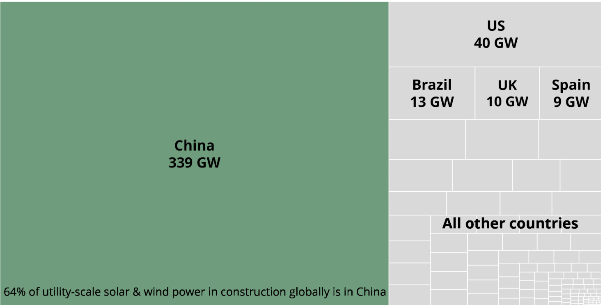
Utility-scale solar and wind capacity by country updated June 2024 for China and Europe, other regions accurate to December 2023. Source: Global Solar Power Tracker, Global Wind Power Tracker, Global Energy Monitor
But is carbon neutrality by 2060, as outlined by President Xi at the 2020 UN General Assembly, achievable? Issues with energy reliability and accessibility have presented barriers to their success. In recent years large-scale power outages due to natural disasters and drought have affected hydroelectric power generation, leaving rural areas in the dark for weeks.
To address these challenges, they have implemented large-scale energy system reform. Construction of an extensive network of ultra-high-voltage (UHV) power lines is well underway and set to transport clean energy long distances from the sparsely populated Western and Northern regions to industrial hubs on the Eastern and Southern coasts efficiently. More than two hundred clean energy bases (combinations of solar arrays and wind farms) will also be established in Eastern China where there is a substantial amount of cheap available land – a move aiming to triple production capacity in the region by 2030. Furthermore, their current regional grids will be combined into a singular nationwide network to manage fluctuations in output from renewable energy sources.
The importance of engaging rural areas which are home to a third of China’s population has also been recognised. The National Energy Administration (NEA) launched the Whole Country PV program, a project which aims to install photovoltaics in half of rural administrations as well as 20% of residential properties. By the end of 2022 more than 51GW of solar capacity had been installed, nearly half of which was on rural rooftops.
As with any complex endeavour, China’s efforts have not been without their faults. Volatility in hydroelectric output has forced many industries to lean on coal. Operators have recognised difficulties in supply and have thus seized what they see as the last opportunity to install new plants – an unsurprising move, considering coal still profits from more hours of grid access than renewables. Issues in translating installed capacity to actual utilisation have prevented renewable energy from being as effective as it could be. Despite accounting for half of China’s installed capacity, renewable energy only accounts for 30% of total generated electricity.
Furthermore, a supply glut has forced producers to seek new markets to absorb excess output. As a result, firms have committed 80 billion USD in clean technology investment overseas over the past year. This has presented a unique opportunity to developing countries seeking to reduce their reliance on imported fossil fuels. For example, development of a 6 billion USD battery factory is underway in Indonesia, as well as an 8 billion USD green hydrogen project in Nigeria, both backed by Chinese suppliers. As Trump’s tariffs come into full swing, these investments have come at an ideal time - when countries are looking to strengthen clean technology ties elsewhere as US cooperation weakens.
China’s Belt and Road Initiative (BRI), launched in 2013, has seen nearly 75% of the world’s population connected by six overland economic corridors and the 21st century Maritime Silk Road. The development strategy aims to enhance global trade across the historic Silk Road, addressing infrastructure gaps in developing countries. In 2025 alone, over 80 billion USD was invested, and nearly 130 billion USD was committed in construction contracts.
In 2017, a consortium of Chinese firms developed the 310MW Lake Turkana Wind Power Project, the largest wind farm in Africa. A significant portion of the funding came from equity financing, a tactical ideal for startups as it alleviates debt pressures, but this dilution of ownership can complicate governance and crowd out local investors. Furthermore, Eric Olander, the co-founder of The China-Global South Project (an independent multimedia organisation assessing China’s engagement with Africa), claims that the 50+ billion USD of financial support pledged at the Forum on China-Africa Cooperation might be directed to benefit Chinese firms more than African stakeholders. It is planned to be used to ‘purchase vast quantities of solar panels, batteries and electric vehicles’ from China.
But with fast-moving African energy regulations, and the majority of African nations receiving low rankings form the World Bank on their ‘ease of doing business,’ it is difficult to fault China for not over-concentrating their allocation of resources. President Xi’s policy of developing ‘green growth engines’ across the continent highlights ‘a shift towards a more structured financing model for climate-resilient projects, focusing on technology transfer,’ said Dr. Isaac Ankara, senior research fellow at the Africa-China Centre for Policy and Advisory. In 2024, 59% of Chinese investment in Africa was directed at solar and wind power projects.
This tactical involvement in the advancement of energy infrastructure in developing countries has ensured their domination of the global supply chain for clean energy technology. They also control 80% of the total output of cobalt from the Democratic Republic of Congo (DRC) – the country producing 80% of the world’s total cobalt supply. This disadvantageous arrangement for the DRC was the result of a 2008 deal while they were economically vulnerable, only recently having emerged from decades of political instability. It has led them to call for greater scrutiny of Chinese involvement in developing nations.
Clean energy projects funded by both Chinese and non-Chinese companies. State-owned Enterprises (SOEs) were involved in 46 and 5 solar and wind projects, respectively. Credit: Carbon Brief.
In spite of these issues, the world is turning to China for climate leadership. Dwindling US commitment to climate policy has resulted in a loss of global momentum, with countries less willing to make sacrifices that they are starting to deem futile. Thus,investment from the Chinese has and will be vital in successfully tackling climate change
Their involvement in COP30 demonstrated this expanding global role; before previous COPs, senior US and Chinese negotiators often held meetings to ensure they were aligned, but this year talks were instead held with the EU. Here they affirmed that they would work together to achieve a successful COP. Although COP30 did not deliver the desired results, it did see China position itself as a reliable partner for the green energy transition by showcasing its leadership in green tech, and resisting trade barriers to its implementation.
China’s decisive response to climate investment after teetering dangerously close to a tipping point exhibits the kind of urgency and efficiency with which the rest of the world must approach climate policy. The extraordinary scale of their renewables sector output has driven down prices worldwide, breaking down the cost barriers which have prevented poorer countries from expanding their renewables sector. These actions have kept China’s economy booming despite them contracting real estate and construction markets – a testament to the importance of realising the potential of the clean energy sector.
China’s position as leader of the clean energy transition has been well-established and is sure to endure for years to come.
Cover Photo: Wind power plants in Xinjiang, China. By 林 慕尧 / Chris Lim from East Coast (东海岸), Singapore (新加坡) - Windmills in China?{D70 series}, licensed under CC BY-SA 2.0, https://commons.wikimedia.org/w/index.php?curid=2909338
https://ourworldindata.org/co2-emissions-metrics
https://www.bbc.co.uk/news/articles/ce85709xdk4o
https://e360.yale.edu/features/china-renewable-energy
https://www.theguardian.com/environment/2025/sep/07/china-fossil-fuel-us-climate-environment-energy
https://center4ee.org/news/chinas-largest-solar-farm-is-doing-a-lot-more-than-generating-energy/
https://greenfdc.org/china-belt-and-road-initiative-bri-investment-report-2025/
https://www.bbc.co.uk/news/articles/cx2yl88wd3lo