Introduction
From quantum computing to Artemis II, technological advancements have progressed at a rate never seen before, and with climate change threatening an ever-increasing number of lives, the world is eagerly awaiting a breakthrough in the way we produce our energy. How will we utilise our newfound understanding of the world to produce more energy, more efficiently? By exploring some of the most exciting new concepts, the future of energy production can slowly be constructed.
Thermovoltaic Systems
One of the most remarkable developing technologies is the advanced thermovoltaic system (ATS). This device converts waste heat back into electricity, greatly reducing energy loss for heavy industries requiring extremely high temperatures, such as cement production. Operating at a whopping 14% thermal conversion rate, this apparatus has the potential to massively improve energy efficiency and abate gigatonnes of CO2 emissions.
Consisting of two metal plates with cartridges of semiconductor pellets wedged in between, these devices utilise the photovoltaic effect to generate current when exposed to heat – operating very similarly to photovoltaic cells on solar panels that use energy from sunlight rather than from heat sources.
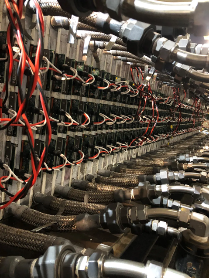
Imagine a world where this technology was introduced everywhere. 14% of all the heat we waste coming straight back into our electricity grid – generating vast amounts of power. Further improvement to this technology will see this thermal conversion rate increase even higher. Inindustry, total energy usage to generate power will reduce, leaving energy leftover to be fed directly into the mains.
This technology is currently limited by its minimum temperature requirement: it will only operate at temperatures between 150 and 500°C. However, AI optimisation will see this technology optimised for cooler conditions, making more widespread implementation possible. Despite its current limitations, ATS’s potential to radically improve efficiency is sure to make a notable change to the carbon footprint of heavy industry.
Pavements of Power
What if the kinetic energy produced by our footsteps could be converted into electrical power? A company named Pavegen is hard at work producing technology meeting this brief – a series of compressible tiles embedded in the pavement.
When stepped on, the tile moves downwards by 10mm. This vertical motion is converted mechanically into rotations, causing a coil to spin within a magnet and induce a current via the generator effect. This current is then fed externally to be stored in a battery or fed into the mains.

One compression of a tile produced enough energy to supply an LED bulb for 20 seconds. When installed over large, high-footfall areas, this electricity production quickly adds up! With time, this technology will become cheaper and could eventually line all major streets, harnessing energy otherwise wasted.
Renewables getting their upgrade
Over a hundred-year period, what enhancements to traditional renewable energy production can we expect? The solution to meeting every-growing demand may be two-fold – involving battery fields and floating wind farms.
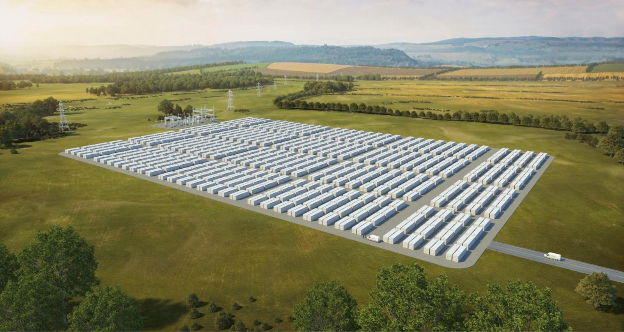
Batteries unlock the true potential of renewable energy, addressing the challenge of intermittent power generation. When renewable energy sources operate at their peak production, batteries will store excess electricity generated, and when extra energy is required to meet peak demands, these batteries will discharge and supply additional power to the grid. By storing this renewable energy, supply will always match demand, and energy waste can be avoided.
Earthshot finalist Form Energy are developing technology for iron-air batteries, a cheaper and reusable alternative to lithium-ion batteries. When exposed to hydroxide ions from an electrolyte in contact with air, iron forms iron-oxide compounds, a process which releases electrons. These electrons flow – supplying current to mains electricity. When charging, electrons are forced back into the iron oxide, reducing the structure back to oxygen and iron which can be reused.
These rechargeable modules are small and can be installed almost anywhere. In a hundred years, we could see this technology supporting renewable energy plants all over the world.
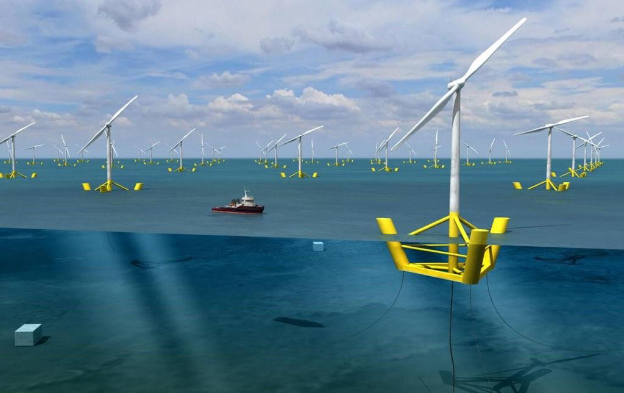
Floating wind farms will enable us to harness vast amount of the strong and consistent wind energy generated further out at sea. By connecting turbines to cables at the bottom of the sea, costs can be reduced as large underwater supports would no longer be needed, meaning quicker and cheaper installation once the industry matures.
Several pioneering floating wind farms are already operational. But what if we could get these farms out further into the ocean? With almost 300MW of capacity already installed, the potential of this technology is immense.
The main issue floating wind farms face is transporting electricity generated back to land, which is currently done via underground power cables. When electricity is transported over long distances, a large portion of the power is lost due to the resistance of the cables. As it currently stands, there is very little opportunity to extend wind farms beyond 100 miles of any coastline as the expense of the low-resistance materials required would be too great to make mass production feasible. However, as material science develops, expansion will be possible and wind farms will be possible almost anywhere.
Harnessing the Ocean
Above all else, harnessing the power of our oceans will be vital in ensuring energy security for the future. Approximately 71% of Earth is covered by water, so learning how to use this space for efficient electricity production will revolutionise power generation as we know it.
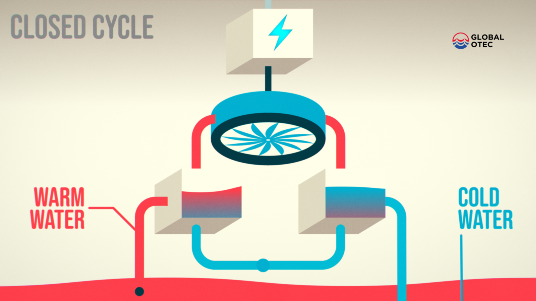
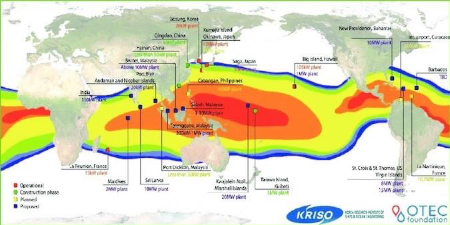
OTEC, an innovative tech company, is attempting to do just this, harnessing temperature differences in sea water to generate electricity with their advanced thermal energy converters. In their systems, warm water at the ocean’s surface functions as a ‘solar battery’ and is used to heat ammonia through a barrier and convert it into a gas. It is then passed through a steam turbine, causing it to rotate, before being converted back into a liquid by cold water extracted from the deep sea. This cycle can be repeated effortlessly, resulting in a simple yet amazingly effective energy extraction technique.
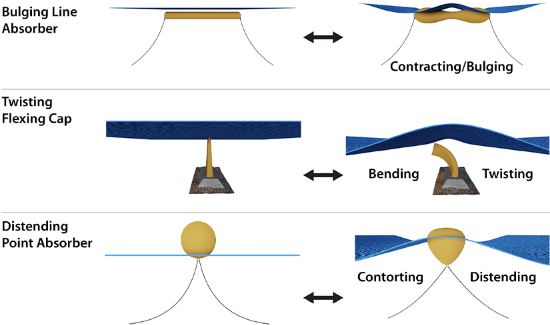
One of the most impressive emerging energy-production technologies is Distributed Embedded Energy Converters Technologies (DEEC-Tec). Made up of many small energy transducers (DEECs), this metamaterial deforms when placed in a body of water with a strong current, generating electricity using a phenomenon called piezoelectricity.
Special piezoelectric crystals consist of a network of polarised molecules. When these crystals are deformed, the stretching/compressing of the molecules induces a potential difference across the crystal. When millions of these crystals are combined in series (creating a polymer-type structure), the magnitude of the induced voltage can become sufficient for power generation. Connecting this system to a complete circuit induces a current through the polymer, thus generating power that can be stored in batteries or fed into the electricity grid. With the potential to line both riverbeds and oceans, this technology could make a real difference to the energy production of the future.
Conclusion
By employing all these technologies, the future of energy production in a hundred years starts to take shape. Thermovoltaic cells supporting heavy industry, pressure-plated tiles embedded in pavements, battery fields scattered nearby renewable energy power stations, and the seas dotted with wind turbines, heat transfer modules, and piezoelectric polymers. Whilst mostly hidden from plain sight, these devices will quietly revolutionise energy generation as we know it. In 100 years, concepts and prototypes will have actualised, shepherding in a new era of clean, innovative energy.
It is only a matter of time!
Boren, B. (2025, Dec 31) Distributed Embedded Energy Converter Technologies, Retrieved from National Laboratory of the Rockies: https://www.nrel.gov/water/distributed-embedded-energy-converter-technologies
Global OTEC (2025, June 23) Understanding the OTEC Cycles: Closed, Open and Hybrid, Retrieved from Global OTEC: https://globalotec.co/understanding-the-otec-cycles-closed-open-and-hybrid/
Form Energy (2026) Battery Technology, Retrieved from Form Energy: https://formenergy.com/technology/battery-technology/
Ennomotive (2024) Future energy: 5 new disruptive energy technologies, Retrieved from Ennomotive: https://www.ennomotive.com/future-energy-disruptive-technologies/
The Earthshot Prize (2024) 2024 Winner Advanced Thermovoltaic Systems, Retrieved from Earthshot: https://earthshotprize.org/winners-finalists/advanced-thermovoltaic-systems/?gad_source=1&gad_campaignid=21823656223&gbraid=0AAAAAo5q2HMUTzYUmheOydaixh_WbCfHp&gclid=CjwKCAiAssfLBhBDEiwAcLpwfi9-1l-U_WjnoKPJRxH35E7J6k_SL30uzNkVX0MHaWkjvHWpighNyBoCYIYQAvD_BwE
Thomson, E. (2023, Aug 31) Here are four innovative ways to generate clean energy, Retrieved from World Economic Forum: https://www.weforum.org/stories/2023/08/four-innovative-clean-energy-solutions/
ATS Energy (2026) Our technology, Retrieved from ATS Energy: https://ats.energy/our-technology/
Pavegen (2026) How it works, Retrieved from Pavegen: https://www.pavegen.com/how-it-works