The intermittency problem
Renewable and clean energies are undeniably the most social and environmentally responsible route to go down for the future of energy generation. Countries and organisations recognise this idea, designing and implementing policy to align with the transition.
But whilst renewable energy has positioned itself as the angel on their shoulder, fossil fuels and an intermittent renewably-powered power grid persistently act as the devil on the other. Successfully enough that the renewable energy’s transitions momentum has begun to dissipate. It no longer has the requisite speed to make it over that final gap, the one that finally lets us leave fossil fuel use behind.
Batteries look as though they are the most important tool towards bridging this gap. A simple idea, already being executed of course, but not without its limitations and shortcomings.
The UK government estimates that 23-27 Gigawatts (GW) of battery storage capacity is needed by 2030. Current capacity is closer to 7GW - still a huge accomplishment, being a 509% increase since 2020. According to Energy Pulse’s research there is over 6GW of capacity under construction, and over 60GW currently consented to, giving hope that targets will be met.
Sadly, this progress is not reflected worldwide, as some countries, such as Brazil and Guyana, continue to double down on fossil fuels in favour of short-term economic prospects, aggressively expanding oil operations in the face of climate dismay.
Batteries enable a choice of energy source, as seen in electric vehicles (EVs) for example. They don’t guarantee ‘greenness’, because batteries can be used to store energy produced from the burning of coal, or from offshore wind farms. However, they are a foundational step in achieving Net Zero by ensuring that when energy production does move towards renewable sources, everyday instruments like cars can utilise that change.
To summarise, batteries give choice and complete the picture of a renewable fuelled world.
Fossil fuels vs renewables at sunset
Fossil fuel burning can continually produce energy, regardless of whatever factors occur outside the generation plant. Renewables cannot. Batteries’ key role in enabling Net Zero is by smoothing out those periods of intermittency in generation by using a surplus of energy collected when conditions were more ideal.
Lithium-ion (Li-ion) batteries are commonplace in all electric industries: personal devices, electric vehicles (EVs), industrial energy storage sector, etc. They are the public masthead for energy storage but not the whole boat. The complexity of electro-chemistry promotes various specialised batteries for different uses and industry need. The requirements for their use and the materials abundantly available, leads to different industries utilising different variants.
Lithium Iron Phosphate (LFP) differs to Nickel Manganese Cobalt (NMC) standard Li-ion batteries by being cheaper, less flammable and possessing a longer lifetime, but at the cost of decreased energy density. This is obviously an issue to the likes of EV industries where space is everything, but to industrial energy storage facilities, it is almost a footnote. Hence the reason why LFP makes up most of the industrial energy storage sector. Interestingly, Chinese EV companies majorly prefer LFP over NMC, representing a divide in the EV priorities of China, compared with other key manufacturing hubs such as North America and Europe. Each battery type has its upsides and, as most things are, it’s a compromise of properties.
Head-to-head, who wins?
What really keeps fossil fuels in play in many scenarios is that they offer a much higher energy density compared to battery stores in a much simpler form. A bag of coal, for example, is a decent method to store energy. In some scenarios coal is 100 times more energy dense than Li-ion batteries and does not require any complex chemical or engineering development. These differences prevent the renewable transition from fully taking hold of the energy sector. This is recognised by organised bodies worldwide and substantial progress is being made in the improvement and advancement of battery technology.
Energy density however is not always the best metric to compare two energy sources. Whilst fossil fuels have a massive advantage on that end, they also have a much lower efficiency compared to batteries. Furthermore, fossil fuels are only a one time use situation.
Think of it as fossil fuels winning the “sprint” of higher energy density, but batteries winning the “marathon” as they allow for thousands of cycles of higher efficiency and produce far less waste from manufacturing.
The winner isn’t clear cut but rather specific to the individual context around it.
The ugly duckling conundrum
Whilst the decision of choosing the direction of the future energy grid is simple to me, unfortunately this is not the case for many countries and organisations. In the news, we are seeing backtrack upon backtrack on Net Zero goals from fossil fuel companies, or certain countries and their president calling the whole idea of a greener world a “scam”.
Organisations with an established infrastructure of pollution and greed, prefer to win the “sprint”, the route which lines their pockets today, at the cost of tomorrow. This is why fossil fuels remain prevalent world-wide. While we can be somewhat proud of the UK’s progress of installing solar and wind farms, not everyone is following the trend trying to be set.
In a world of high demand for energy, whether that be due to AI, or consistent overconsumption of modern society, the path of fossil fuels has enough ease to discourage these organisations and corporations from investing in a greener future. This indicates that advancements in battery understanding must be made, to demonstrate to resistant bodies that what they may currently fear could become an economic advantage to them, and that investing is the safest step forward.
Renewable energy leaders in the world need to continue to support the battery industry and incentivise the switch in the hopes of others following.
The next frontier of batteries
An exciting recent headliner is Solid State Batteries (SSBs), which take a different path with the construction of the basic battery using a solid electrolyte rather than a liquid version. There are many more differences, but this is by far the most fundamental. SSBs offer over two times the energy density of a standard Li-ion alternative, accompanied by a lower fire risk. This is great news for the EV market and could redesign the car market as it improves the biggest issues which hold back petrol and diesel drivers from making the jump: range anxiety (previously capped at 600km), risk of thermal runaway, and battery fires.
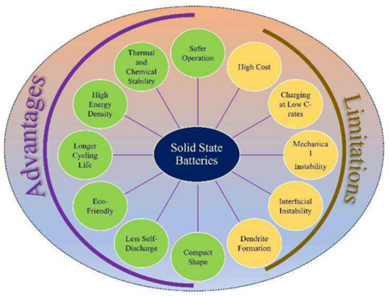
Toyota is the lead automotive manufacturer investing in the technology and predicts that SSBs could be commercially available as soon as 2027. However, there are limitations in its design which must be first resolved before it can be a fully functional and safe alternative for energy storage.
Unfortunately, SSBs are not a viable option to the energy storage sector, regardless of their technological superiority, because of the huge price tag that accompanies them. LFP batteries are far cheaper, which compensates for their shortcomings in energy density. As a result, SSBs are currently reserved for high end EVs but may play a part in the future markets.
Conclusion and closing remarks
Batteries undoubtedly have lower energy density than fossil fuels, as well as other limitations, and this may discourage some people from the idea of a battery built future, but it really should not.
But I think it’s important to understand why we want a strong energy storage system. It’s not necessarily to beat the capacities that fossil fuels allow – this does not seem possible in the near future – instead, we want a strong energy storage system because we want to replace that previous system.
Batteries are a solution is that could feasibly bridge the gap between current fossil fuel use and future renewable use. Are they perfect solution? No. But they are an imperfect solution that might just work.
Sources
https://www.iea.org/reports/batteries-and-secure-energy-transitions
https://www.sciencedirect.com/science/article/pii/S0306261925002764
https://www.lsprenewables.com/news/the-importance-of-energy-storage-in-the-current-climate-crisis