The End of Fossil Fuel Dominance - are they finally losing their grip on global energy
Human use of fossil fuels dates back to as early as 4000BC. Asphalt was used to construct mosaics, bitumen (found seeping from the ground) was used to construct the walls of Babylon, and bamboo pipes were used to transport natural gas for heating and lighting during the Chinese Zhou dynasty in 500BC. Post-Industrial Revolution, fossil fuel consumption began to look a bit different, with Watt’s steam engine, Benz’s automobile and military tanks and warships all running on fossil fuels. They were cheap, energy-dense, and reliable, transforming our everyday and enabling otherwise unprecedented technological advancements.
But surging populations during these times were accompanied by booms in energy demand, readily facilitated by fossil fuels. And we are yet to reach peak consumption levels. According to the International Energy Agency’s (IEA) 2025 World Energy Outlook, whilst coal consumption is plateauing, gas consumption is only set to peak in 2035, and oil in 2030. This outlook includes a post-peak consumption decline which is decidedly less marked (with oil consumption 5% higher in 2050 and gas usage rising until 2035 rather than 2030) and examines the small possibility of a growth in coal consumption.
The IEA also reintroduced a pathway where demand continues to rise for decades - a pathway which has since been resurrected after pressure from the US (a chief funder of the agency). This scenario, referred to as the ‘Current Policies Scenario’ (CPS), assumes only current legislation is continued, and addresses a situation where Trump continues to dismantle plans phasing out fossil fuels with world leaders following suit. Under the CPS, the IEA warns that warming could reach 2.9°C by 2100.
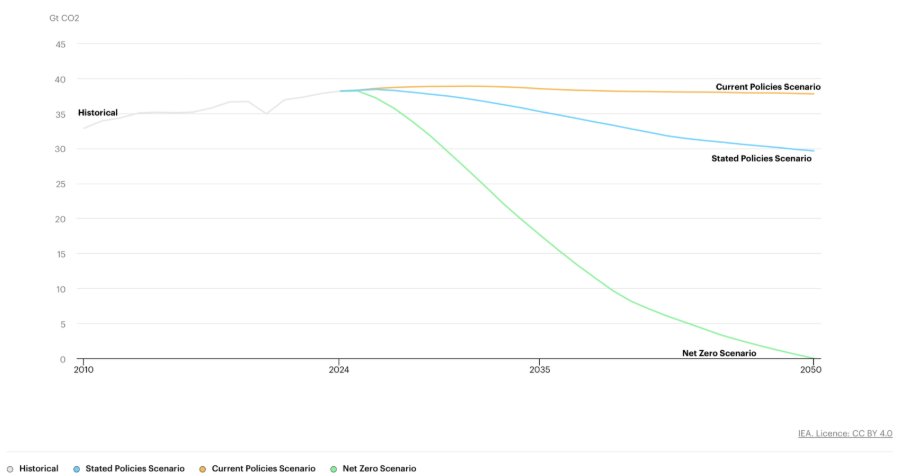
Out of the 20 major fossil fuel production nations, only the UK, Australia, and Norway plan to reduce production by 2030, with estimates expecting production to be double the quantity that would be consistent with meeting the 1.5°C Paris Agreement target. There is also a risk that as electrification drives decreased primary energy demand, the fossil fuels industry would experience a rebound effect, becoming cheaper as demand dips.
The world is no stranger to the many manifestations of climate change, with regions across the UK seeing their wettest Januarys on record affect agriculture and transport infrastructure. The wet winter of 2024 alone saw the agriculture sector face one billion GBP in losses from damaged crops. And it is not just farms; the Environment Agency expects one-in-four properties to face flood risks by 2050. But the growing cost of our inaction has been predominantly borne by the global South where severe droughts, floods, and storms have become commonplace in places such as Somalia - which experienced 223 different flood or drought events in 2023 compared to three in 2013.
So why the lack of urgency?
US energy policy under Trump has played a considerable role in slowing down the switch to renewables. After withdrawing from the Paris Agreement for the second time, he ordered the US military to increase their coal power consumption to boost flagging domestic industry and address a lack of reliability from fossil fuels. Not only has he driven the investment of billions of USD into coal, but he has also spread dangerous rhetoric concerning renewables - in a speech at Davos he labelled those who buy wind power as ‘stupid people’. European investment has already been affected, with the EU pledging to buy triple the amount of American oil, gas and nuclear than it currently does after tariff threats.
This shift in attitude concerning clean energy from being about climate policy to politics is striking but has in fact accelerated clean energy movement. In 2025, wind and solar generated 30% of the EU’s energy.
Another, perhaps more unexpected, culprit has been the poor management of an oversubscribed UK grid connections pipeline. It can, and has, taken up to 15 years for new projects to connect. This time last year, Ofgem reported 765GW of energy projects (many of which were renewable) languishing in the grid connection queue, which has grown tenfold over the last 5 years, held up by ‘zombie’ projects (speculative or stalled projects blocking legitimate ones).
The National Energy System Operator (NESO) have since abandoned their first-come first-served policy for a more effective system that prioritises operations-ready renewable projects. However, to properly rectify grid issues, Neara (an Australian software company) argue more energy should be transmitted through the existing grid. By using their AI predictive modelling platform, they stress-tested the grid’s response to increased energy flow and found current maximum operational temperature (MOT) limits to be overly conservative. These underutilised lines reduce grid flexibility, meaning excess renewable energy can go to waste, leaving a gap which fossil fuels have been filling.
Infrastructure and supply chain bottlenecks have also presented obstacles to getting clean energy projects up and running. Projects often compete for the same assets, making development painfully slow and ramping up costs. For example, there is a limited number of vessels equipped to handle the 14-15MW turbines used in many new wind farms. Furthermore, the port expansions required to facilitate the operation of these offshore wind farms have been held up by 6-10 years wait-times from permit to operation. Streamlining the connection process will speed up this process and deliver the investment needed to electricity operations.
Despite technological advancements and growing renewable energy generation, grids worldwide are still relying on baseload power from fossil fuels. Gas generators make up more than half of the UK’s top 25 single emission sources (despite generation being at its lowest level in 25 years), and aviation has slowly become responsible for a greater share of the UK’s total emissions than the entire electricity supply sector. Incremental increases in the use of sustainable aviation fuel (SAF) and the development of electric-/hydrogen-powered aircraft have been slow, and consequently, the government has been considering a tax on more frequent flyers
Where is innovation responding?
The National Infrastructure Commission forecasts that electricity demand will rise by 50% between now and 2035 and will double by 2050. Innovation is rising to meet this growing challenge. Whilst a backbone of renewables and nuclear might bear much of this load, they will need the support of an array of other solutions to ensure energy reliability and to see all industries decarbonised. A fundamental part of this is, of course, batteries. This sector is not short on investment or attention: last year the world’s largest sand battery, delivered by Polar Night Energy (a Finnish company specialising in industrial scale thermal energy storage) went live. The 13x15m device uses a sand-like material called soapstone to store renewable energy as heat for months and can deliver 1MW of geo-thermal power with 100MWh of storage capacity. Heat is extracted by blowing cool air through pipes in the battery, and this air is then used to convert water to steam, or to heat water for heating directly.
Progress in industries that are particularly difficult to decarbonise is also accelerating. The Japan Engine Corporation (J-ENG) are targeting a launch of their dual-system ship engine that operates on ammonia and heavy fuel oil (HFO) this year, aiming to help the shipping industry reach its (suitably) ambitious 2050 net zero target. Liquid ammonia will be stored in closely monitored, low-pressure tanks to manage its toxicity, and 700+ hours of undergone meticulous testing has yielded encouraging results. J-ENG has proved the engine has a thermal efficiency equivalent to or greater than that of solely HFO-driven engines, and by utilising a selective catalytic reduction (SCR) system, they have ensured all ammonia is burned. This means halved NOx emissions and a staggering 90% reduction in GHG emissions (using a 95% ammonia co-firing rate). The decarbonisation of shipping has been tackled in other ways: HGK shipping launched the Blue Marlin, a hybrid solar-powered inland cargo vessel, in July of last year in German waterways.
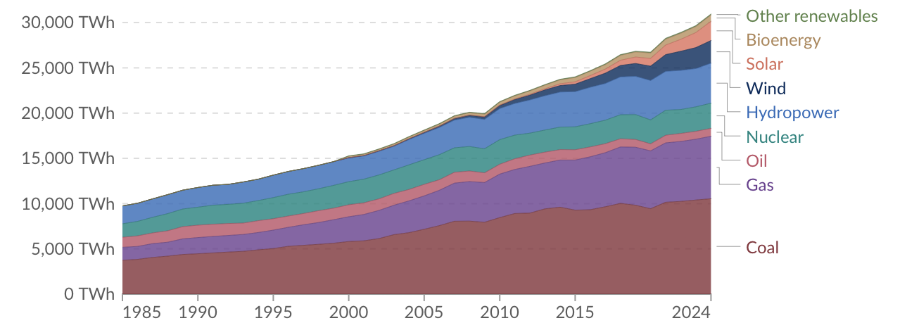
Since 2010, the IEA has calculated reductions in the cost of solar, wind and batteries by of 90%, 70% and 90% respectively since 2010, with further declines expected by 2035. Nuclear energy output is expected to double by 2050, and solar output growing nine-fold by the same time. The stubborn domination of fossil fuels is evidently on its way out.
Uruguay has proved a rapid, complete fossil fuel phase out possible. Méndez Galain, a theoretical physicist and Uruguay’s energy minister from 2008 to 2015, tackled the nation’s growing dependence on imported fossil fuels and decreasing supply reliability with a total structural shift towards renewables. Today, 99% of their electricity comes from a diverse mix of renewables, the bulk of which is hydropower and wind, with biomass and solar filling in the gaps. Electricity production has seen costs halved as a result. Replicating this model in countries with larger economies however may prove tricky, with costly increases in storage and improved transmission infrastructure stalling progress. But Méndez argues ‘it's just a matter of designing the rules to use them efficiently’, and that the Goldilocks-like conditions present for Uruguay’s transition (namely their significant hydropower resources to support intermittent renewable generation, and consistent government policy such as the elimination fossil fuel subsidies) are not unique as the ‘principle is the same’, and that ‘when we eliminate the strong biases that favour fossil fuels, renewables emerge as the clear winner’.
So, the great transition of energy generation from ugly duckling to swan presses on. A transition that would not be possible without fossil fuels. Many of the materials and processes used to manufacture, transport, and construct renewable energy plants are made from or powered by the very fuels they are replacing. Though this dependency will be transitional, with embedded carbon ‘pay back’ and the electrification of industrial processes, fossil fuels are and have been fundamental to our progress: contributing to both the development of renewable, clean energy sources and to our growth as a civilisation.
Sources:
https://eandt.theiet.org/2025/06/10/co2-pollution-captured-and-converted-cement-precursor-new-study
https://www.germanwatch.org/sites/default/files/2025-11/CRI%20summary%20EN%202026.pdf
https://oilprice.com/Energy/Energy-General/The-Complete-History-Of-Fossil-Fuels.html
https://edition.cnn.com/2026/02/19/climate/trump-wind-europe-clean-energy-independence
https://www.bbc.co.uk/news/articles/cvgjw0kpd89o
https://www.j-eng.co.jp/en/news/20250901.html
https://www.gov.uk/government/news/clean-energy-projects-prioritised-for-grid-connections
https://www.iea.org/reports/world-energy-outlook-2025/overview-and-key-findings#abstract